
The buck converter has been built to reduce the DC voltage, using only nondissipative switches, inductor and capacitors. The switch produces rectangular waveform vs(t) as illustrated in Figure 2-1.
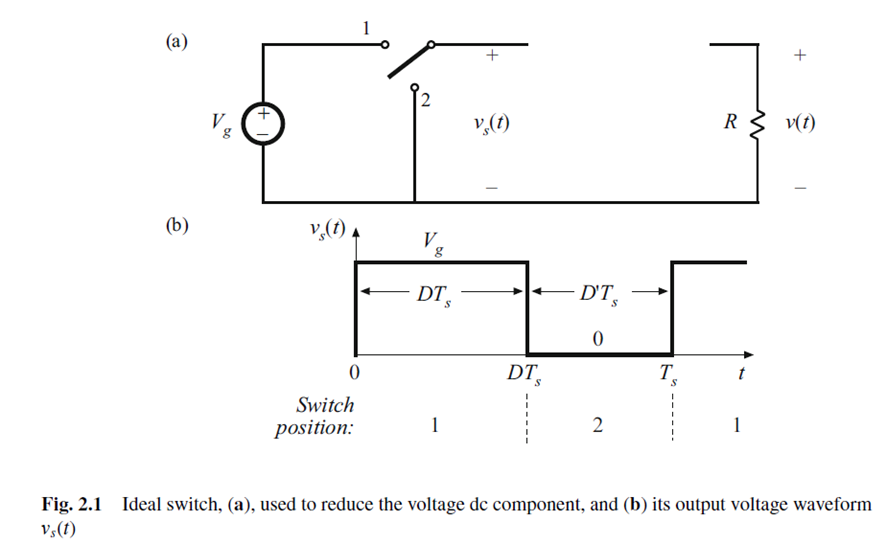
In practice, the switch is realized using power semiconductor devices, such as transistors and diodes, which are controlled to turn off and on as required to perform the function of the ideal switch. The switching frequency fs is in the range of 1KHz – 1MHz, depending on the switching speed of the semiconductor devices. The duty ratio D is the fraction of time that the switch spends in position 1, and is a number between zero and one. The complement of the duty ratio, D’, is defined as (1- D). As we know from Fourier Transform, the DC component of a periodic function as vs(t), is given by its average value <vs(t)>:
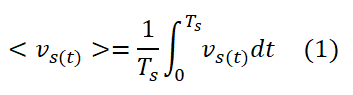
Solving equation (1) we obtain the following solution as illustrated in Figure 2-2:

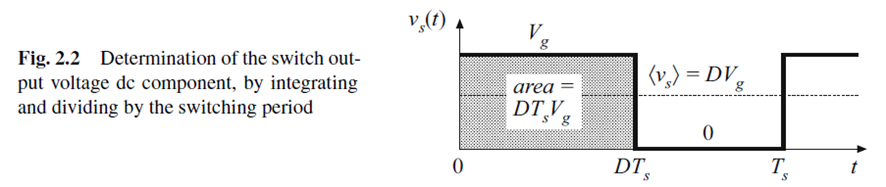
Equation (2) confirms that the DC component of the voltage output vs(t) of the buck converter is equal to or lower than the input voltage vg. In the practice, vs(t) is not ideal, so it has harmonic components. In consequence, the converter has to have a filter integrated on it. What remains is to insert a low-pass filter as illustrated in Figure 2-3:
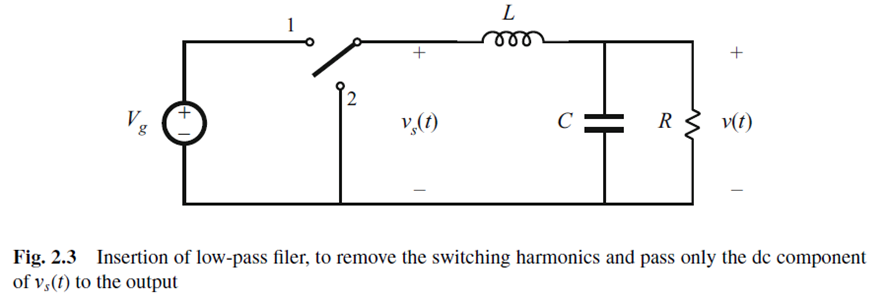
The filter is designed to pass the DC component of vs(t), but to reject its components at the switching frequency and its harmonics. To accomplish this, we design the filter such that its cutoff frequency is much lower than the switching frequency. So, the output v(t) voltage from Figure 2-3, is essentially equal to the DC component of vs(t):

The network of Figure 2-3 allows control of the output. Figure 2-4 is the control characteristic of the buck converter:
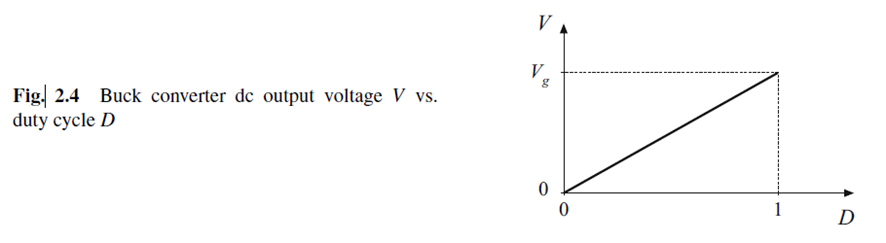
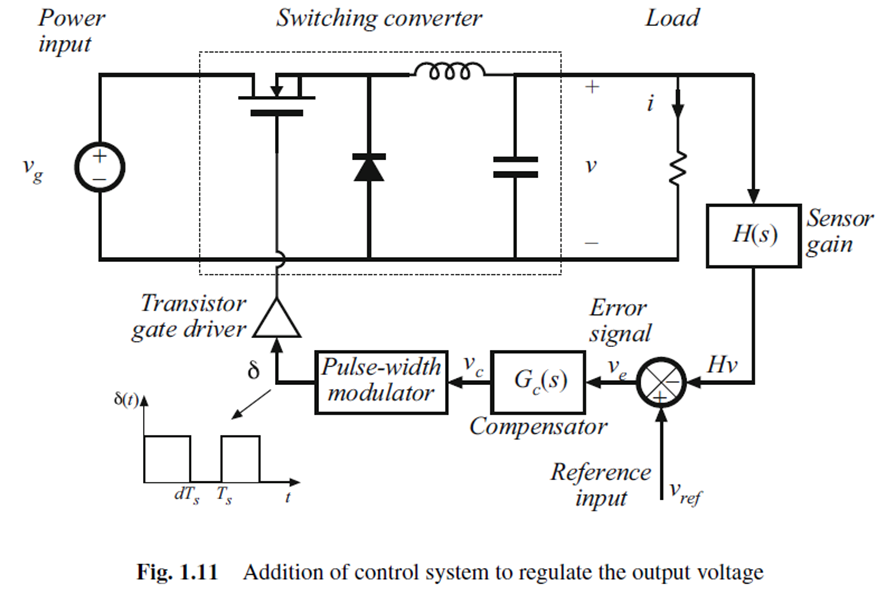
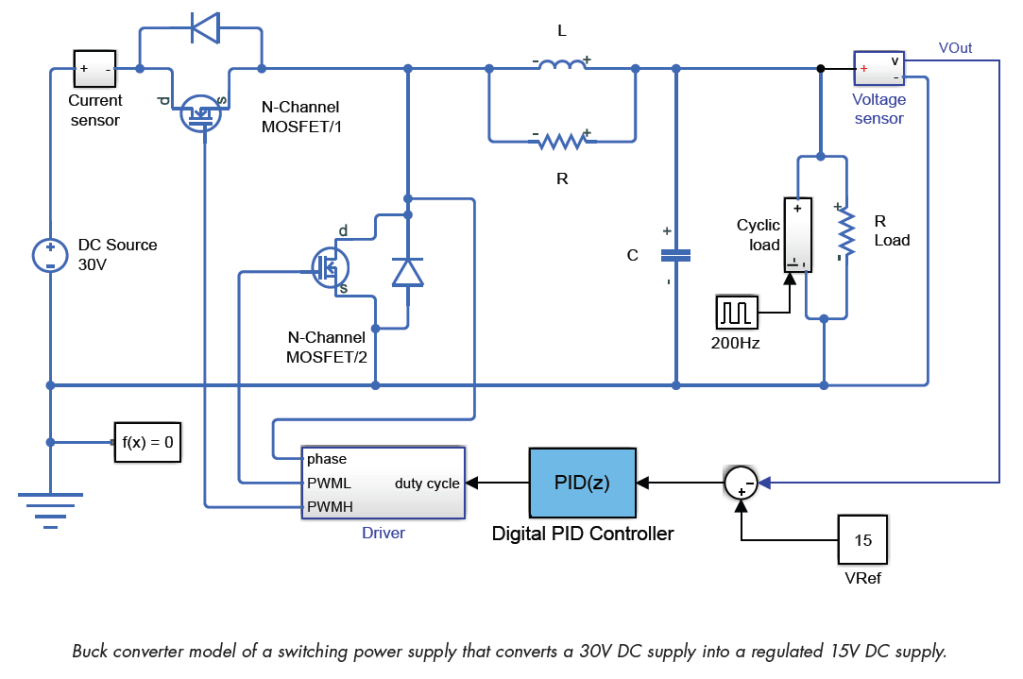
So, the buck converter has a linear control characteristic. Feedback systems are often constructed that adjust the duty ratio D to regulate the converter output voltage, such as in Figure 1.11:
Source:
- Erickson R., Maksimovic D. Fundamentals of Power Electronics.Pp15-18.
NEXT: The small ripple approximation – Chapter two
Literature review by Larry Obando – Electrical Engineering
Universidad Simón Bolívar – Universidad Central de Venezuela
Mathematical modeling and simulation services
Contacto – Whatsapp +34633129287
dademuchconnection@gmail.com
 dademuchconnection